Maximize Jib Crane Span & Load Efficiency: Buyer Guide
menu_open
Content Quick Link
Key Takeaway
Optimizing jib crane span and load ensures maximum coverage, improves workflow efficiency, reduces operational downtime, and prevents overloading risks.
Key Questions Solved in This Guide:
- How to calculate the maximum span and load for different jib cranes
- How to match jib crane capacity to workflow requirements
- How structural conditions affect crane performance
- How to future-proof your crane investment
Key Takeaways in Bullet Format:
- Understand the relationship between span, lifting capacity, and operational safety.
- Correctly select crane type based on workspace layout and load distribution.
- Identify building and foundation requirements before installation.
- Optimize crane coverage without exceeding rated load limits.
- Plan for future workflow expansion and changes in lifting needs.
Why Span and Load Matter for Jib Cranes
Span and load aren’t just numbers on a spec sheet—they define how well a jib crane works in your space. The span determines how far the crane can reach across a workstation or production line. The load rating tells you the maximum weight it can lift safely. Getting either of these wrong can slow operations, increase maintenance costs, or create serious safety risks.
Optimizing both means balancing coverage with safe lifting. A longer boom may sound ideal, but lifting at full reach reduces the crane’s safe capacity. Conversely, a crane built for maximum weight but with a short reach may leave areas of your workspace out of reach, creating workflow bottlenecks.
Common Mistakes Buyers Make
- Oversizing the crane – Picking a crane bigger than you actually need can be expensive and cumbersome. It often increases installation costs and adds unnecessary weight for your structure to handle.
- Ignoring structural limits – Wall-mounted or freestanding cranes require proper support. Failing to evaluate columns, foundations, or beams can lead to unsafe setups.
- Skipping maintenance planning – Even a well-designed crane needs regular inspections. Neglecting lubrication, trolley checks, or hoist maintenance reduces lifespan and can cause unexpected downtime.
Practical Tip for Buyers
Before ordering a jib crane:
- Map out the work area and note all points where material needs to be lifted.
- Check the building structure to confirm it can handle the crane’s full span and load.
- Plan a simple maintenance schedule to keep the crane running smoothly over time.
A little planning up front ensures the crane you choose is safe, efficient, and reliable for daily operations—no surprises, no compromises.
Maximum Span
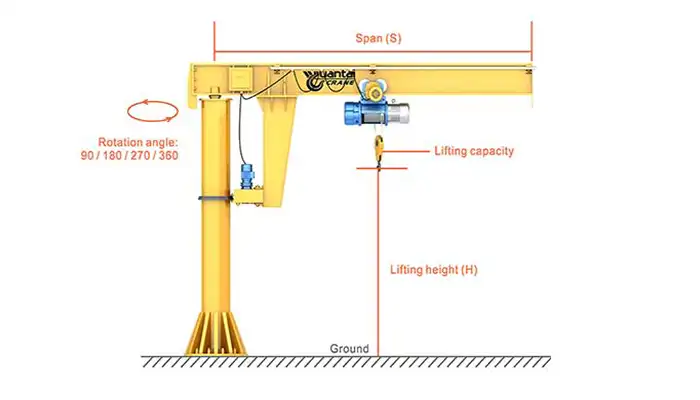
Span is the horizontal reach of the jib crane, from its pivot point to the farthest lifting point. It defines how much of your workspace the crane can cover without needing to move. A properly selected span ensures you can lift materials efficiently, while a poorly chosen span can leave areas unreachable or overload the crane at full extension.
Factors That Affect Maximum Span
Several key factors influence how far your jib crane can safely reach. Understanding these will help you choose the right crane for your workshop or facility.
- Structural support
The type and strength of the support directly determine the maximum span. Wall-mounted cranes rely on the strength of the wall, whereas freestanding masts need a solid foundation or floor support. A weak structure limits reach, while a sturdy support allows longer spans without compromising safety. - Counterweight and boom strength
The boom's design and the counterweight system balance the load, especially at the farthest point of reach. Insufficient boom strength or counterweight can reduce the safe span and increase wear on the crane over time. - Load distribution along the boom
How the weight is applied along the boom affects span capacity. Heavy loads near the tip reduce safe lifting capacity, while evenly distributed or shorter lifts allow for a longer effective span. Planning for load placement ensures safety and operational efficiency.
Practical Span Examples
Different crane capacities naturally lead to different practical spans. Here's what you can typically expect:
- Light-duty cranes
For smaller workshops or assembly areas, spans of 3 to 6 meters are common. These cranes handle moderate weights and are ideal for repetitive lifting at close distances. - Medium-duty cranes
Spans around 6 to 12 meters suit fabrication shops, machine shops, or medium-lift operations. They balance reach and lifting capacity for versatile applications. - Heavy-duty cranes
Cranes with spans of 12 meters or more are used in steel plants, large warehouses, or heavy material handling. These cranes cover wide areas but require strong support and careful load planning.
Quick Tip for Buyers
Before finalizing a jib crane:
- Map your workspace to see where materials need to be lifted. A slightly longer span can save time if workflows change.
- Consider how lifting at full extension affects load capacity. Check load charts to avoid overloading.
- Future-proof your crane for potential expansions or layout adjustments, ensuring it continues to cover all critical points efficiently.
Determining Maximum Load
The maximum load of a jib crane isn't just a number on a specification sheet—it defines how much weight the crane can safely lift at different points of its span. One key detail buyers often overlook is that the safe lifting capacity decreases as you move toward the outermost reach of the crane. Understanding this relationship helps prevent accidents and ensures your crane operates efficiently without overstraining components.
Importance of Accurate Load Calculations
Calculating the correct load is about more than just knowing the heaviest item. You need to consider how often and how the crane will be used to avoid under- or overestimating capacity.
- Single lift vs. continuous operation
Lifting a heavy load occasionally is different from repeated cycles throughout the day. Continuous operation generates more wear on the hoist, trolley, and boom. Make sure the crane's load rating accounts for how frequently it will be used. - Dynamic loads
Loads are rarely perfectly still. Swaying, sudden starts or stops, and unevenly shaped materials introduce extra stress. These dynamic forces reduce the effective lifting capacity and should be factored into calculations to avoid overloading. - Safety factors recommended by industry standards
Most industrial guidelines recommend including a safety margin—typically 25–30% above your maximum expected load. This accounts for human error, material inconsistencies, and unexpected conditions, keeping operations safe without unnecessarily oversizing the crane.
Effects of Load on Crane Longevity and Maintenance
Lifting heavier loads more frequently doesn't just affect immediate safety—it influences long-term performance. Higher loads accelerate wear on structural components, wheels, hoists, and motors. Regular inspections, lubrication, and adherence to load charts are essential to extend the life of the crane and avoid unexpected downtime.
Quick Tip for Buyers
- Always check load charts at both mid-span and full reach to ensure the crane can safely handle expected materials.
- Factor in dynamic forces, not just static weight, when selecting crane capacity.
- Include safety margins recommended by standards to protect equipment and operators.
Coverage Optimization Strategies
Optimizing crane coverage isn't just about reach—it's about getting materials where they need to go safely and quickly. A poorly planned crane can leave gaps, force extra moves, or slow down production. Thoughtful planning improves workflow, reduces downtime, and keeps operators safe.
Match Crane Type to Your Workflow
Every workspace is different, and the type of crane you choose directly affects coverage.
- Wall-mounted cranes – Perfect for tight workshops or assembly lines where floor space is limited.
- Freestanding mast cranes – Ideal for open areas or warehouses without strong wall support; allows longer reach and more flexibility.
- Semi-portal cranes – Great for areas with low ceilings or partial obstructions; balances reach and installation simplicity.
Tip: Choose a crane type that fits your workspace layout, not just the biggest capacity.
Position Cranes to Maximize Coverage
Placement matters more than size. A strategically positioned crane reduces unnecessary moves.
- Map all workstations and lift points.
- Ensure each crane covers its assigned zone with minimal overlap.
- Avoid gaps that require additional lifts or extra equipment.
Example: In a machining workshop, a single wall-mounted crane placed centrally can often cover all stations efficiently, eliminating the need for multiple cranes.
Coordinate Multiple Cranes in Shared Areas
Large workshops may need more than one crane. Without planning, they can get in each other's way.
- Assign specific zones for each crane.
- Mark travel paths and rotation limits to prevent collisions.
- Train operators to be aware of other cranes in overlapping areas.
Practical Note: Even small adjustments in lift paths or travel stops can prevent accidents and boost throughput.
Adjust Boom Angles, Trolley Travel, and Extensions
Some work areas have obstacles, corners, or hard-to-reach spots.
- Use adjustable boom angles to reach around obstructions.
- Extend trolley travel or add modular extension arms for extra reach.
- Flexibility reduces the need for additional cranes and structural modifications.
Example: A freestanding crane with an extendable jib can service both an assembly line and nearby storage racks efficiently.
Plan for Future Changes
Production lines evolve, and your crane should too.
- Modular cranes allow adjustments to span, rotation, and trolley paths.
- Plan for expansions or workflow changes to avoid costly downtime later.
- Check that future lifting needs won't exceed crane capacity.
Tip: Investing in flexibility upfront saves both money and operational headaches in the long run.
Buyer Checklist for Coverage Optimization
- Measure your workspace and mark all lift points.
- Decide whether a single crane or multiple cranes is more efficient.
- Consider modular or adjustable cranes for future-proofing.
- Identify obstacles and plan boom or trolley adjustments accordingly.
Structural & Installation Considerations
Before buying or installing a jib crane, understanding your building's structural capacity is critical. The crane's span, lifting capacity, and overall stability all depend on whether the walls, columns, or floors can handle the weight. Installing a crane without checking structural limits can lead to unsafe operation, costly repairs, or even catastrophic failure.
Floor and Wall Strength
The first step is evaluating whether your facility can support the crane.
- Check wall-mounted points for strength, thickness, and material type.
- For freestanding cranes, confirm the floor or foundation can handle both the crane weight and the maximum lifted load.
- If the structure is weaker than required, consider reinforcement or an alternative crane type.
Practical Tip: Bring an engineer or structural specialist to measure load capacity before installation. A small adjustment in wall or foundation support can prevent major problems later.
Mounting Types
Different mounting options impact crane coverage, installation complexity, and operational safety.
- Cantilever jib cranes – Extend out from a support structure, ideal for reaching over obstacles or tight spaces.
- Pivot-mounted cranes – Rotate from a fixed base, offering 180°–360° coverage in a single area.
- Track-mounted cranes – Run along a rail system for longer coverage along aisles or production lines.
Tip: Choose a mounting type that matches your workspace layout, load requirements, and workflow. Misaligned mounting can create blind spots or overstrain the support structure.
Electrical Supply and Hoist Compatibility
Your crane's performance depends on proper power and hoist integration.
- Confirm voltage compatibility with local supply to avoid underpowered or unsafe operation.
- Check that your chosen hoist type—wire rope or chain—matches the trolley and crane load rating.
- Consider speed options and control methods to balance efficiency and safety.
Practical Note: A mismatch between hoist, trolley, and crane can reduce lifespan and create maintenance headaches, even if the crane is structurally sound.
Clearance Requirements
Adequate clearance ensures smooth and safe operation.
- Measure headroom from floor to ceiling, accounting for hoist height at maximum lift.
- Ensure the crane can travel freely without hitting adjacent equipment, racks, or walls.
- Mark operational safety zones to keep workers clear during lifting operations.
Example: A crane installed too close to storage racks may limit boom rotation or trolley movement, forcing operators to make unsafe adjustments.
Buyer Checklist for Structural and Installation Readiness
- Verify wall, column, and floor strength with a structural assessment.
- Select the mounting type that fits your workspace and lifting needs.
- Confirm hoist and trolley compatibility with your electrical supply and load requirements.
- Measure headroom, check adjacent obstacles, and plan safety zones.
Practical Tips for Buyers
Buying a jib crane is a significant investment, and small oversights can lead to costly mistakes or unsafe operations. Practical planning and site preparation help ensure the crane meets your workflow requirements, operates safely, and lasts for years with minimal downtime.
Conduct Site Surveys and Load Tests Before Purchase
Before ordering a crane, it's essential to measure and assess the actual workspace.
- Verify all lift points, ceiling heights, and obstacles.
- Conduct load tests or simulate lifting scenarios to confirm the crane can handle real-world materials.
- Check structural integrity of walls, floors, and foundations to ensure they can safely support the crane and its maximum loads.
Tip: A proper survey prevents surprises during installation and ensures the crane is suitable for your workflow from day one.
Compare Single vs. Dual-Trolley Solutions for Large Spans
Large spans can be served in different ways, and the trolley configuration matters.
- Single trolley systems – Often simpler, cost-effective, and easier to maintain. Suitable for moderate spans and uniform loads.
- Dual trolley systems – Provide better load distribution over long spans and improve stability for heavy or uneven loads.
- Consider how your workflow affects travel, lift points, and material distribution when deciding between the two.
Practical Note: Understanding your workflow and material handling patterns ensures you select the most efficient system without overbuilding.
Review Third-Party Inspection and Certification Requirements
Compliance is not optional if you want safe and reliable operation.
- Check that the crane and components meet CE, ISO, or other relevant standards.
- Third-party inspections help identify potential issues before they cause downtime or safety incidents.
- Certification also simplifies insurance and regulatory compliance.
Tip: Even if the supplier provides documentation, an independent verification gives added confidence and peace of mind.
Consider Modular Designs for Flexible Span Adjustments in the Future
Workflows change, production lines evolve, and your crane should be able to adapt.
- Modular cranes allow span or boom adjustments without replacing the whole system.
- Trolley or boom extensions can be added to reach new work areas as your operation grows.
- Flexible designs save costs over the long term by accommodating future changes.
Practical Note: Investing in modular or adjustable cranes upfront may cost slightly more initially, but it prevents expensive upgrades later.
Quick Buyer Checklist
- Conduct detailed site surveys and real-world load tests.
- Evaluate whether a single or dual-trolley system best fits your workflow.
- Verify certifications and consider third-party inspections.
- Explore modular designs to accommodate future expansion or workflow changes.
FAQ – Common Buyer Concerns
Answers to the most common questions buyers have when selecting a jib crane, helping ensure safe, efficient, and well-planned operations.
Q1: Can a jib crane reach multiple workstations efficiently?
Yes—but it depends on careful planning. The crane's span and rotation radius must cover all the areas where materials need to be lifted. If the crane is undersized, operators will have to make extra moves or use additional equipment, which slows down workflow. Mapping out lift points and checking the rotation limits ensures the crane can serve multiple stations safely and efficiently.
Q2: Does the maximum load decrease as the crane extends?
Absolutely. Most cranes are rated for their maximum load near the pivot point. As the boom or jib extends toward its farthest reach, the safe lifting capacity decreases. This happens because longer reaches increase leverage on the boom and support structure. Always check the manufacturer's load charts and make sure your operational plan accounts for reduced capacity at full extension.
Q3: How do I know if my building can support a freestanding jib crane?
Structural assessment is key. Freestanding cranes rely on a solid foundation or floor to handle both the crane weight and the maximum lifted load. Wall-mounted cranes depend on strong walls or columns. Engaging a structural engineer to evaluate foundation strength, wall thickness, and floor load capacity ensures your crane is safe and avoids expensive retrofits later.
Q4: Can I upgrade my jib crane later to handle heavier loads?
Sometimes, yes. Modular cranes or cranes with adjustable booms and trolleys allow upgrades to lift heavier loads or reach farther spans. However, upgrades are only safe if the structural support and hoist are compatible with the new specifications. Always confirm with your crane supplier or an engineer before planning upgrades to avoid overstressing components.
Q5: Which type of jib crane is best for small workshops vs. large industrial plants?
It depends on space, workflow, and lifting requirements:
- Small workshops – Wall-mounted or semi-portal cranes usually work best. They are easier to install, cost-effective, and cover the required area without occupying floor space.
- Large industrial plants – Freestanding or track-mounted cranes are better suited. They handle heavier loads, cover wider areas, and offer greater flexibility for multiple lift points.
Tip: Always match the crane type to the workflow, not just the heaviest load you need to lift. Efficiency comes from coverage and flexibility as much as capacity.
Optimizing jib crane span and load isn’t just about choosing the strongest crane—it’s about matching equipment to workflow, structural capabilities, and long-term operational goals. Proper planning minimizes downtime, protects employees, and ensures your investment delivers reliable performance over time.

Article by Bella ,who has been in the hoist and crane field since 2016. Bella provides overhead crane & gantry crane consultation services for clients who need a customized overhead travelling crane solution.Contact her to get free consultation.